

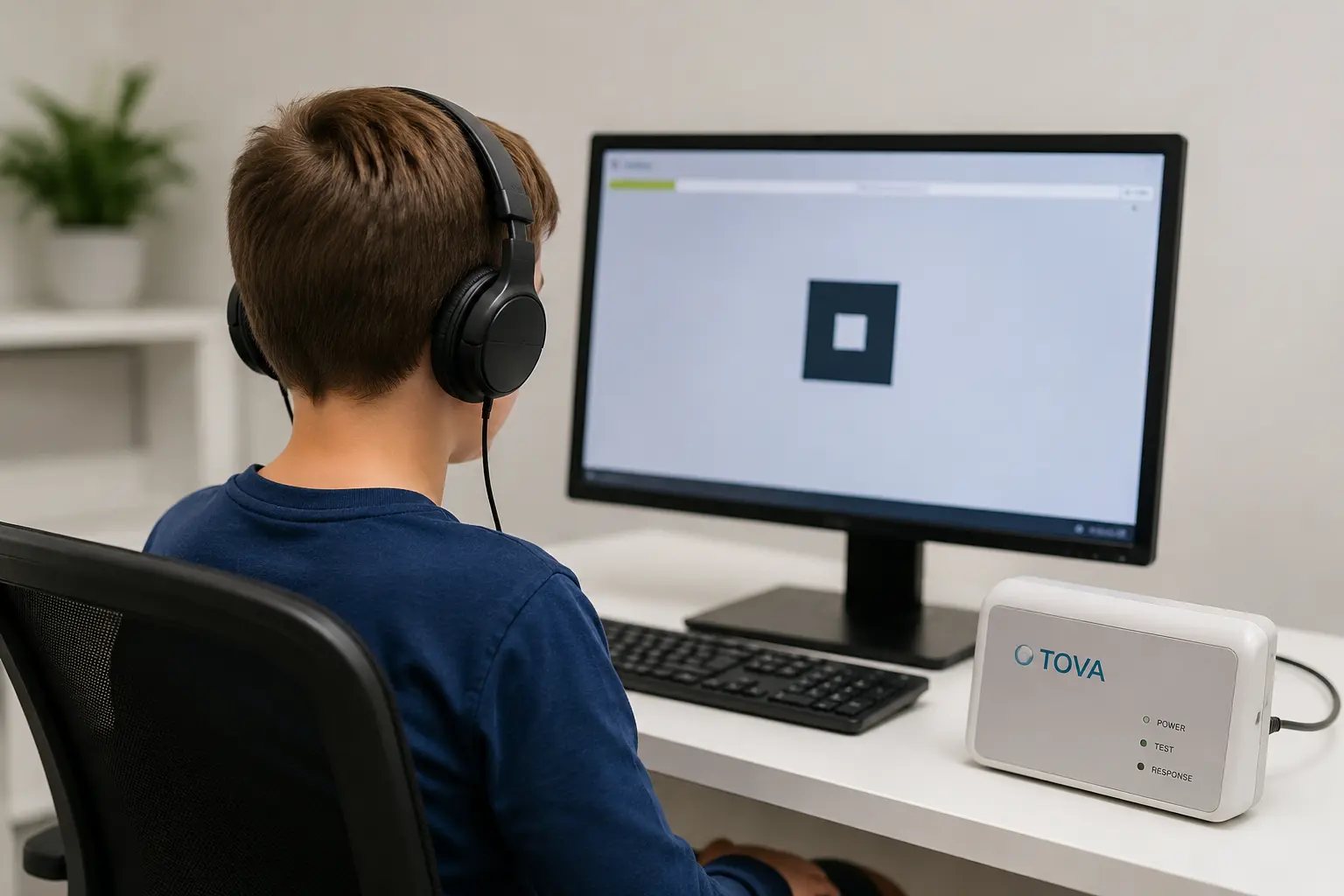
ADHD can make life difficult and feel messy from day to day. You might have trouble getting things done, focusing in meetings, or controlling impulsive behavior. Diagnosis of ADHD is usually based on self-reports and observations of others. Those insights are important, but can be subjective too. That’s why objective tools like the TOVA test can be useful.
The TOVA (Test of Variables of Attention) is an FDA-cleared computerized test that measures attention, impulsivity, and inhibitory control. It provides clinicians with quantifiable data to make a more complete ADHD assessment.
This guide will explain how the TOVA test works, who it is for, what to expect during the test, how the results are interpreted, and the main benefits and limitations. If you’re thinking about getting tested for ADHD for yourself or a loved one, this overview will help you get a better understanding of the process and make you feel more informed.
Understanding ADHD and the Need for Objective Testing
Attention-Deficit/Hyperactivity Disorder (ADHD) is a persistent pattern of inattention, hyperactivity, and impulsivity that interferes with daily life. Some common problems are difficulty staying focused, fidgeting, distractibility, interrupting others, and impulsivity. Symptoms can vary widely. Some people have more trouble with inattentiveness, others tend toward hyperactivity, and many are a combination of the two.
Traditional diagnostic methods depend greatly on clinical interviews, self-reports, and rating scales by parents, teachers, or partners. These tools remain important, but they have limitations of their own. Symptoms of ADHD often overlap with anxiety, depression, sleep disorders, trauma, or even high intelligence, so it can be difficult to determine what is causing a person’s struggles. Also, people may exaggerate or minimize their symptoms because of embarrassment, lack of insight, or pressure from others. Cultural and gender biases may also distort the perceptions of evaluators and peers about certain behaviors.
This is where objective tools like the Test of Variables of Attention (TOVA) make an important difference. The TOVA offers objective, quantifiable data on actual cognitive performance under controlled conditions. It does not replace a full clinical assessment but complements it perfectly by adding tangible, data-driven evidence to the diagnostic picture. Think of it as a sort of “stress test” for your attention system.
What Is the TOVA Test? History and Development
Dr. Lawrence Greenberg developed the Test of Variables of Attention (TOVA) in the 1960s, which reliably tests attention deficits. The TOVA has been refined continuously for decades since its move to a computerized format in the 1990s. Now, it’s an FDA-cleared medical device for diagnosing attention disorders, like ADHD, and assessing treatment responses for the visual test.
The TOVA provides both visual and auditory testing. For ages 4 to 80+. Preschoolers can enjoy a specially adapted, shorter version of the visual version. The audio version, in the meantime, is for the age group of 6 – 29. It is free of all culture and language because it is based purely on simple geometric shapes or simple auditory tones. This inclusive design effectively reduces biases related to a patient’s educational, linguistic, and cultural background.
How Does the TOVA Test Work?
Test Format and Duration
The Testing of Variables with Attention (TOVA) is similar to participating in a very simple video game, but instead of sitting at a computer screen competing against others, you are alone in an isolated area responding to electronic cues presented on a monitor through the use of a microswitch (a highly sensitive additional button). In the case of participants 6 years of age and older, the test is administered for approximately 21.6 minutes. For those between 4 and 5 years old, the test is delivered in an estimated time ranging from 10.5 minutes to 11.5 minutes.
The assessment is divided into two distinct halves:
- Infrequent Targets (First Half): This section presents mostly non-targets with only a few valid targets. This less stimulating environment is designed to challenge your sustained attention and overall vigilance.
- Frequent Targets (Second Half): This section presents mostly targets alongside rare non-targets. The faster pace tests your impulsivity and your ability to control inhibitory responses.
Your task is simply to press the button for targets and refrain from pressing it for non-targets. The microswitch’s precise timing captures even the most subtle variations in your performance.
What the Test Measures
The TOVA tracks several key performance variables to build a complete profile of your attention:
- Omissions: Missed targets, which indicate inattention or a lapse in focus.
- Commissions: Incorrect responses to non-targets, which reflect impulsivity.
- Response Time: How quickly you react to targets, which measures your processing speed.
- Response Time Variability: How consistently you pay attention throughout the test—a hallmark metric for ADHD.
- Additional Metrics: The test also measures signal detection sensitivity and includes performance validity indicators (such as the Symptom Exaggeration Index for adults) to detect invalid testing efforts.
Visual vs. Auditory TOVA
The test can be administered in two formats. The visual version uses simple shapes, such as a square appearing at the top or bottom of a computer screen. The auditory version relies on two distinct tones. Many clinicians use both versions to gain a comprehensive understanding of a patient’s attention span across different sensory pathways, particularly if there are underlying concerns about visual or auditory processing.
Who Should Take the TOVA Test?
The TOVA test is suitable for children (ages four and up), teenagers, and adults who suspect they have attention issues. It is also highly beneficial for individuals experiencing academic or workplace difficulties or those needing to monitor an ongoing treatment plan.
Healthcare professionals commonly use this test during initial assessments to help confirm a diagnosis, evaluate the effectiveness of prescribed medications, or rule out attention deficits when overlapping symptoms are present.
Important Note: The TOVA is not a standalone diagnostic tool. To ensure an accurate diagnosis, it must be used as part of a comprehensive medical evaluation that includes a detailed patient history, clinical interviews, and other relevant assessments.
Preparing for and taking the TOVA Test
On the day of your test, you will be seated in a quiet, distraction-free environment where a clinician will provide you with clear instructions. The test itself is completely straightforward: you simply respond by pressing a button. Many people describe the experience as intentionally boring—which is exactly the point! The repetitive nature of the test can feel tedious, but this is ultimately what helps reveal your real-world attention challenges. Additionally, built-in validity measures ensure that your results reflect genuine effort.
Tips for Preparation:
- Rest well: Get a full night’s sleep before your appointment.
- Eat smart: Enjoy a light meal beforehand, avoiding heavy or sugary foods that could temporarily impact your focus.
- Follow clinician guidelines: Adhere strictly to any specific instructions from your provider, such as avoiding caffeine or adjusting certain medications.
- Communicate openly: Be honest about how you are feeling, as factors like your current medication status are typically recorded to ensure accurate results.
Understanding TOVA Test Results and Interpretation
The test presents your results as standard scores, with an average of 100 and a standard deviation of 15. It compares these scores to age- and gender-matched norms, as well as an established ADHD sample. If your scores fall significantly below average—typically around 80 to 85 or lower—this may indicate difficulties in specific areas.
Certain scoring patterns can point to inattentive, hyperactive-impulsive, or combined ADHD presentations. Additionally, the ADHD Comparison Score (ACS) evaluates your performance directly against individuals diagnosed with ADHD. You will receive these findings in a comprehensive report featuring easy-to-read graphs, tables, and narrative summaries.
A qualified clinician must interpret these results. TOVA scores should never be viewed in isolation; instead, your clinician will combine these findings with your complete medical history to provide accurate and actionable insights.
Benefits and Reliability of the TOVA Test
The TOVA test is highly regarded for its objectivity, precise millisecond timing, and extensive research support, featuring hundreds of peer-reviewed studies. It reliably and accurately measures attention variables, boasting sensitivity and specificity rates that typically fall between 70% and 90%, depending on the specific study and demographic.
Key advantages of the TOVA test include its speed, non-invasive nature, and cultural fairness. It is particularly useful for monitoring treatment progress, such as adjusting medication dosages, and generates data that is consistently difficult to fake. For many patients, the results are incredibly validating, as the test proves their attention struggles are scientifically measurable and not just “in their head.”
Limitations and Considerations
While the TOVA is a helpful tool, it is not without its flaws. It cannot be used to diagnose ADHD on its own, as it may produce false positives or negatives. Furthermore, high-functioning individuals or people who enjoy highly engaging tasks (such as gamers) might perform better on the test than they would in real-world scenarios. Because the assessment measures performance in a strictly controlled setting, it often fails to accurately reflect the dynamic, unpredictable environments of daily life.
Additionally, the cost of the test can fluctuate, and insurance coverage is not always guaranteed. Experts caution against relying too heavily on any single assessment. Instead, TOVA results should always be viewed as just one piece of a much larger diagnostic puzzle.
TOVA Test vs. Other ADHD Assessments
| Assessment Type | Strengths | Limitations | Best Used For |
| TOVA (CPT) | Objective, quantifiable measures of real-time performance | Doesn’t capture real-world context alone | Objective data on attention/impulsivity |
| Rating Scales (e.g., Conners, Vanderbilt) | Multi-informant, real-life behaviors | Subjective bias | Symptom history & impact |
| Clinical Interviews | Deep context, history | Relies on recall | Full diagnostic picture |
| Other CPTs | Similar objective metrics, some add distractors | Variety in research base | Complementary objective testing |
| Neuropsychological Batteries / qEEG | Broader cognitive profile, brain activity | More time-intensive, costly | Complex cases or comorbidities |
The TOVA is most powerful in a multimodal evaluation.
Cost, Accessibility, and Next Steps
Understanding the Costs
The TOVA test typically costs between $100 and $400+. Since it is often administered as part of a comprehensive ADHD evaluation, your total out-of-pocket expenses could range from hundreds to thousands of dollars. Always check with your healthcare provider and insurance company to understand your coverage options.
Finding a Provider and Taking Action
Look for licensed psychologists, psychiatrists, or specialty ADHD clinics that offer the TOVA test. Once you receive your results, you can collaborate with your clinician to build a personalized support plan. Your customized approach might include:
- Behavioral therapy or coaching
- Medication (if appropriate)
- Lifestyle adjustments (such as improved sleep, exercise, and nutrition)
- Workplace or educational accommodations
Helpful Resources
To connect with qualified professionals or learn more about navigating an ADHD diagnosis, explore local mental health directories, The TOVA Company website, ADDA, or CHADD.org—the nation’s leading nonprofit organization serving people affected by ADHD.
You Are Not Alone
If you or a loved one struggles with attention, seeking clarity is a powerful first step. Objective assessment tools like the TOVA can help you better understand your unique brain wiring and guide you toward effective support.
Have questions about the testing process or your results? Reach out to a qualified healthcare provider, or share your experiences in the comments below. You deserve compassionate, informed care.